The Challenge in Strawberry Production
Strawberries are predominantly grown from young plants through tray plant propagation, and it is precisely during this stage that the foundation for the entire growing season is established. Growers and plant propagators increasingly face the same key challenges:
✓ Weak root development in young plants. A limited root system during the propagation phase slows the uptake of water and nutrients, resulting in slower recovery after planting and increased plant losses.
✓ Calcium deficiency in young plants. Leaf-edge burn caused by insufficient calcium uptake is a recurring problem in tray plants and directly reduces the commercial usability of the plant material.
✓ Plant health under pressure. Pathogens such as Phytophthora cactorum, powdery mildew and Verticillium are constant threats in both substrate and soil-grown production, becoming particularly problematic when the root system or plant is weakened.
✓ Uneven plant losses and quality. Variation in plant quality within a batch results in a lower proportion of commercially viable plants, leading to greater losses for the propagator.
✓ Increasing pressure to reduce fertilizer use. Even in young plant production, growers need to reduce inputs without compromising plant quality or growth rate.
The Resilient Growing System
In REKA's Resilient Growing System, the fertilisation of young strawberry plants is tailored to leaf sap analysis, using organic fertilisers and biostimulants.
Vici Fix is the next step within this system.
By improving nutrient uptake in young plants, Vici Fix supports the development of a stronger and more uniform root system, resulting in lower plant losses and a higher proportion of commercially viable plants.
How It Works in Practice
Following application, Vici Fix colonizes the root system of the strawberry plant. The fungal network increases the effective root surface area from 5 cm² of root system to 250 cm² of fungal hyphal network enabling the plant to utilize a much larger volume of growing medium for water and nutrient uptake.
For strawberry production, this translates into stronger, more uniform young plants with a better-developed root system, fewer cases of calcium deficiency, and a higher proportion of plants meeting quality standards.
Practical results in tray plant propagation:
+18.77% commercially viable plants
-62% fewer cases of calcium deficiency
+30% longer petioles
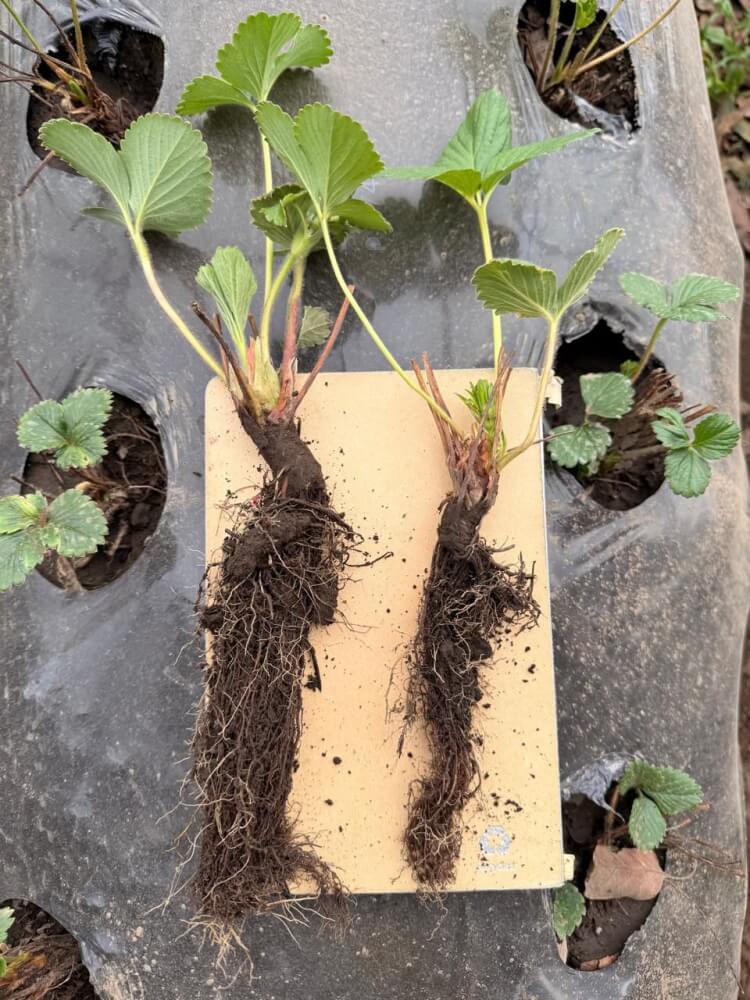
+38% greater root volume and biomass
+54% greater leaf biomass
+59.77% greater total biomass
Left: treated roots — Right: untreated roots