The challenge in banana production
Current production systems put soil life under pressure. It shows in persistent soil challenges such as plant-parasitic nematodes, Fusarium Tropical Race 4 (TR4) and Moko disease. They all point to the same underlying problem: a lack of life in the soil.
✓ Weak root development in young nursery plants
✓ Plant losses in the nursery and during field establishment
✓ Uneven quality and a lower share of commercially viable plants
✓ Growing pressure to cut fertiliser use without compromising plant quality or growth rates
The Resilient Growing System
A strong banana plant starts in the nursery. That's why it pays to stimulate root development in the earliest phase and to make sure the roots are colonised by beneficial soil organisms. These organisms help the young plant build a larger root system and use water and nutrients more efficiently.
By inoculating young plants with mycorrhiza early, we build resilience from the start. Vici Fix is the foundation that further soil life builds on. Through the fungal network, the sugars the plant releases from its roots reach the existing soil life.
The result is fewer plant losses, a higher share of commercially viable plants and better plant nutrition.
How it works in practice
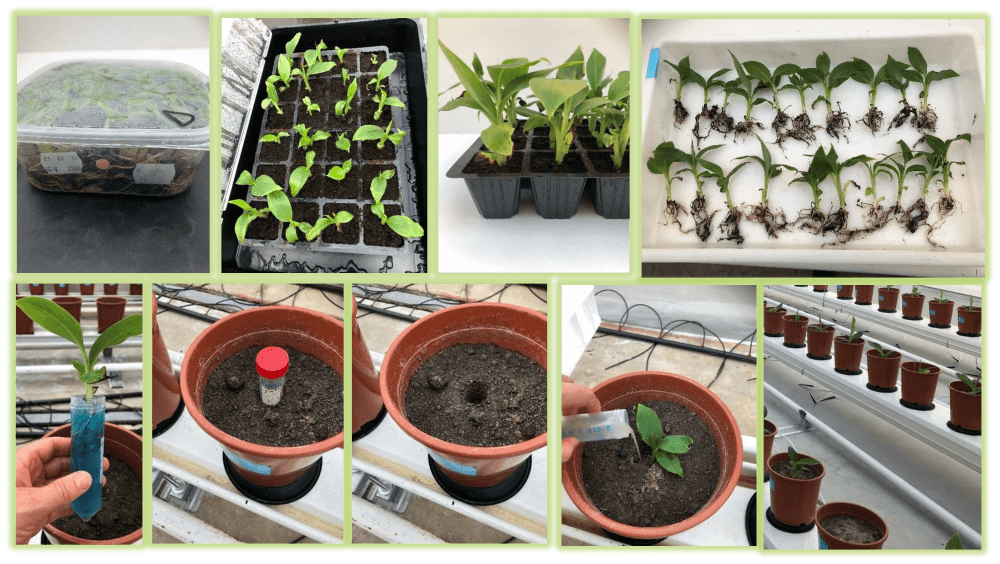
Vici Fix is applied in the nursery when the young banana plantlets are potted. The mycorrhiza colonises the root system, and the fungal network extends the effective root surface. Early inoculation clearly improves plant growth and root development, which gives bigger, more resilient plants. After transplanting, reduced plant losses in the field have also been observed.
Results in the nursery
Plant biomass at transplant (vs. untreated, depending on dose)
✓ +42% / +63% / up to +129% more plant biomass
Improved plant nutrition
✓ +25–65% higher phosphorus (P) content
✓ +30–120% higher sulphur (S) content
✓ +10–50% higher potassium (K) content
✓ +40–120% higher nitrogen (N) uptake
✓ +60–190% higher potassium (K) uptake
Combined with organic fertiliser
✓ +30–80% more shoot and root biomass (statistically significant, p < 0.01)
In the field
✓ Fewer plant losses after transplanting